
Ever slammed on the brakes and felt your whole body lurch forward? Or tried pushing a heavy box and realized it takes way more effort than sliding a backpack? That’s Newton’s work in action.
Over 300 years ago, Sir Isaac Newton wrote down three laws that still explain everything from rocket launches to rollercoaster whiplash. These aren’t just “science facts.” They’re the framework of how motion always works.
Newton’s First Law: The Law of Inertia
“An object at rest stays at rest, and an object in motion stays in motion, unless acted on by an unbalanced force.”
This means:
- Nothing starts moving unless something makes it move.
- Nothing stops moving unless something slows it down.
Examples:
- A coffee cup doesn’t slide off your desk by itself.
- You lurch forward when a car suddenly stops.
- Astronauts float effortlessly in space because nothing’s there to stop them.
This property is called inertia. The more mass an object has, the more inertia it has. Inertia is why moving a piano is way harder than sliding a chair.
Newton’s Second Law
“The acceleration of an object depends on the net force acting on it and its mass.”
This law gives us the formula:
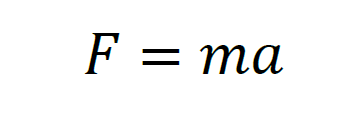
If you apply the same force to a feather and a brick, the brick barely moves while the feather takes off. Mass resists acceleration.
This explains:
- Why heavier objects need more force to move.
- Why sports cars accelerate faster than trucks.
- Why astronauts on the Moon (with less gravity pulling on them) can bounce around so easily.
This law is basically the engine of motion.
Newton’s Third Law: Equal and Opposite Reactions
“For every action, there is an equal and opposite reaction.”
Push on a wall, it pushes back.
Jump off a skateboard, it rolls the other way.
A rocket blasts exhaust downward, the ship goes upward.
This is why:
- You feel impact when you punch something.
- Guns kick back when fired.
- Floors don’t collapse under you (your weight pushes down, the floor pushes back up with equal force).
Every force comes in pairs. Action. Reaction. Always.
Why These Laws Matter
Newton’s laws explain basically everything in daily life:
- Riding a bike → 1st: you keep coasting if you don’t brake, 2nd: pedaling harder makes you accelerate faster, 3rd: wheels push back against the ground to move you forward.
- Playing football → tackles involve big mass + big acceleration = big force.
- Walking, sitting, running, throwing—all of it is Newton’s rules in motion.
Once you know these laws, you can predict how objects will move in almost any situation.
Newton’s Laws of Motion aren’t just things to memorize. They’re the backbone of physics. If something moves, these laws explain why. If something doesn’t move? Same thing.
So next time something falls, slides, collides, or spins, ask yourself:
- Is it inertia?
- Is it force?
- Is it reaction?
Chances are, the answer is Newton.
 Techne Colored