You’re moving right now—whether you notice it or not. Even sitting still, you’re riding Earth as it spins and flies through space at about 67,000 mph.
Wild, right?
But before we start launching rockets or dodging asteroids, we need the basics. Let’s talk about motion in one direction: just forwards or backwards. No curves, no angles.
What Is Motion?
Motion is simply a change in position over time.
We describe it using a few key terms:
- Distance: How much ground is covered.
- Displacement: How far you are from where you started (including direction).
- Speed: How fast something is moving (distance ÷ time).
- Velocity: Speed plus direction (for example, 5 m/s east).
- Acceleration: How quickly velocity is changing.
Distance vs. Displacement
If you walk 3 meters forward, then 3 meters back:
- Distance = 6 meters (you walked that much ground).
- Displacement = 0 meters (you ended up where you started).
Key idea: distance doesn’t care about direction. Displacement does.
Speed vs. Velocity
- Speed is a scalar: it tells you only how fast.
- Velocity is a vector: it tells you how fast and in what direction.
Example: A car driving at 60 mph = speed. A car driving 60 mph north = velocity.
Acceleration
Acceleration is any change in velocity over time. That means:
- Speeding up = acceleration.
- Slowing down = acceleration (just negative).
- Changing direction = acceleration (even at the same speed).
The unit is meters per second squared (m/s²), which means “how much speed changes each second.”
Graphing Motion
Two main graphs show motion:
Position vs. Time
- Straight line = constant speed
- Curved line = changing speed (acceleration)
- Slope = velocity
Velocity vs. Time
- Horizontal line = constant velocity
- Sloped line = acceleration
- Area under the curve = displacement
Kinematic Equations
When acceleration is constant, these equations are the main tools:
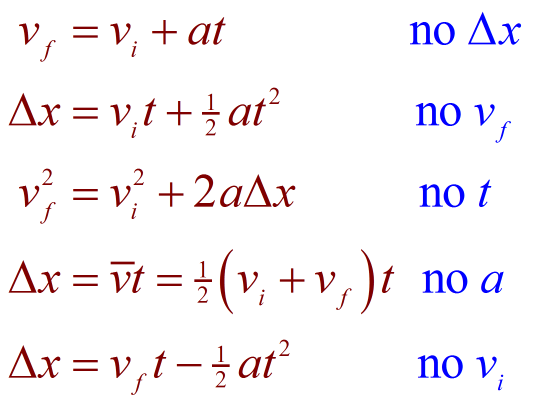
Where:
- vi = initial velocity
- vf = final velocity
- a = acceleration
- t = time
- x0 = starting position
- x = final position
They all answer the same basic questions: How fast? How far? How long?
Why It Matters
Everything in physics builds on this. Motion in one dimension is the foundation. It shows up in:
- Driving a car
- Dropping a ball
- Launching a rocket (it starts with vertical motion!)
Once you understand straight-line motion, you’re ready for two dimensions, circular paths, and beyond.
Motion in one dimension may be simple, but it’s powerful. It’s in your walk to school, a pitch in baseball, even your character moving in a video game.
The equations might feel heavy at first, but with practice they’ll become second nature. Physics doesn’t always have to be complicated. Sometimes, it just moves in a straight line.
 Techne Colored