If life is made of cells, the next question is obvious: what do they actually do?
Short answer: a lot.
Long answer: they’re like microscopic cities: constant traffic, communication, and nonstop work. Cells are alive, active, and shockingly smart.
Let’s dive into the amazing world of cells and explore their functions, types, and why they matter so much.
What Is a Cell?
A cell is the smallest unit of life that can carry out all the processes we associate with being alive—like using energy, growing, reproducing, and responding to the environment.
Every living thing is either:
- Unicellular – made of just one cell (bacteria)
- Multicellular – made of many cells (you!)
Cell Functions: What Do Cells Actually Do?
Every cell, whether it’s a lone bacterium or a brain cell in your head, has to:
- Take in nutrients
- Convert nutrients into energy (metabolism)
- Get rid of waste
- Grow and divide
- Respond to signals
- Maintain balance (homeostasis)
Cells are highly efficient, self-sustaining machines. But what makes them work so well?
🧩 Meet the Organelles: Cell “Organs”
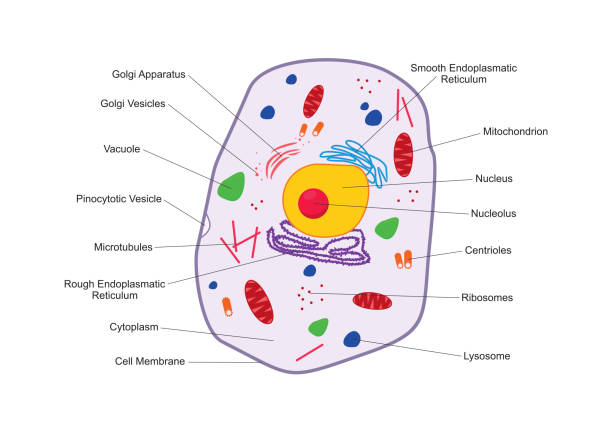
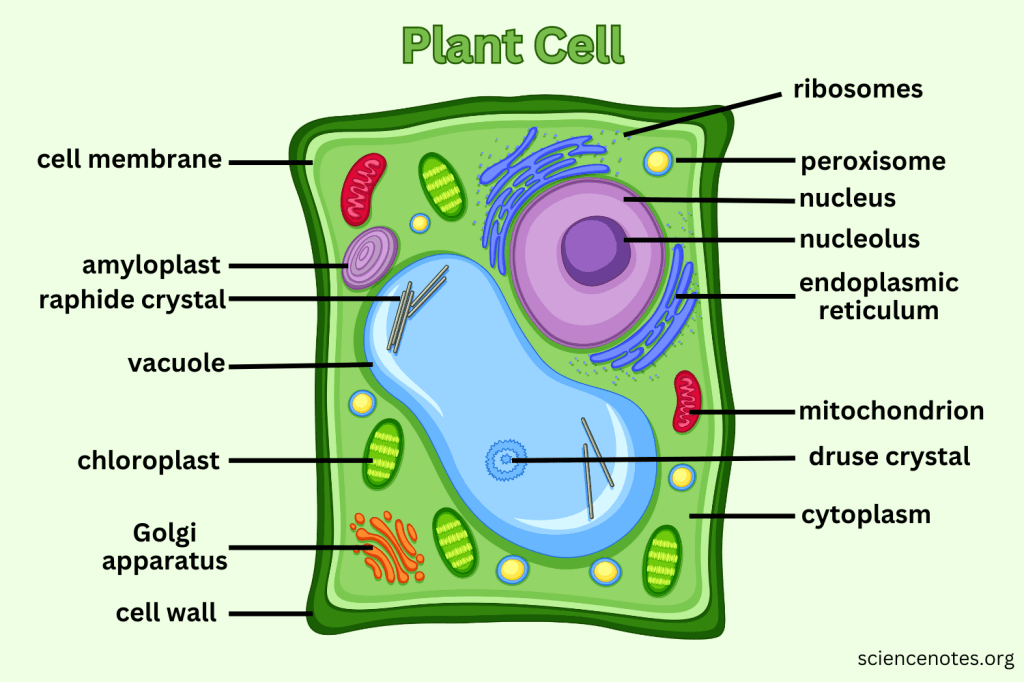
Inside cells are tiny parts called organelles (think: mini-organs), and each has a specific job:
| Organelle | Function | Nickname |
| Nucleus | Holds DNA, controls cell | The Brain |
| Mitochondria | Produces energy (ATP) | The Powerhouse |
| Ribosomes | Build proteins | The Construction Crew |
| Endoplasmic Reticulum (ER) | Transports & folds proteins | The Highway |
| Golgi Apparatus | Packages and ships proteins | The Post Office |
| Lysosomes | Break down waste | The Recycling Plant |
| Cell Membrane | Controls what goes in/out | The Security Guard |
| Cytoplasm | Jelly that holds everything | The City Ground |
If it’s a plant cell, add:
- Chloroplasts – do photosynthesis
- Cell wall – gives shape and support
🔬 Two Main Types of Cells
There are two types of cells, and every living thing has one or the other:
🦠 1.
Prokaryotic Cells
- Simple and small
- No nucleus (DNA floats around)
- No organelles
- Example: bacteria
2. Eukaryotic Cells
- Complex and larger
- DNA in a nucleus
- Lots of organelles
- Examples: plants, animals, fungi, protists
Specialized Cells: Not All Cells Do the Same Job
In multicellular organisms, cells specialize:
- Muscle cells contract to move your body
- Nerve cells send signals across long distances
- Blood cells carry oxygen or fight infections
- Skin cells protect your body from outside dangers
They all start from the same kind of cell (called a stem cell) but develop into different types through a process called differentiation.
Cells may be tiny, but they are mighty. They build bodies, fight infections, think thoughts, grow forests, and power the entire food chain. Every breath you take, every step you walk—thank your cells.
They’re not just little blobs—they’re the most efficient workers in the universe.
 Techne Colored