Everything you hear, everything you see, even the Wi-Fi you’re using to read this is all thanks to waves.
Waves are how energy moves from one place to another. Whether it’s the sound of your favorite song or the sunlight hitting your skin, wave motion is everywhere. And once you get how waves work, you’ll start to notice the little ripples in the world.
What Are Waves?
A wave is a repeating disturbance that transfers energy, not matter. That means the particles themselves don’t travel far—they just vibrate, passing energy along like a relay race.
There are two major types of waves:
1. Mechanical Waves
- Need a medium (solid, liquid, gas) to travel
- Examples: sound waves, water waves, seismic waves
2. Electromagnetic Waves
- Can travel through vacuum (no medium needed)
- Examples: light, radio, X-rays, Wi-Fi
This lesson focuses mostly on mechanical waves, especially sound.
Wave Anatomy: The Parts of a Wave
Let’s break it down:
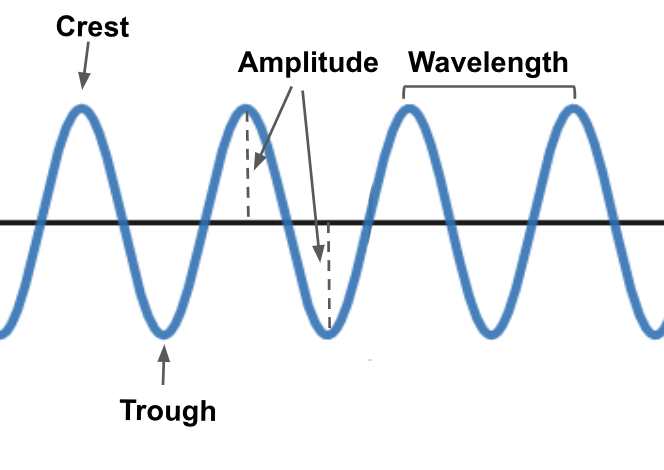
- Wavelength (λ) – the distance between two identical points on a wave (like crest to crest)
- Amplitude – the height of the wave; how “intense” or loud the wave is
- Frequency (f) – how many waves pass a point per second, measured in hertz (Hz)
- Period (T) – the time it takes one wave to pass, measured in seconds
- Speed (v) – how fast the wave moves
The wave speed formula is:
v = fλ
So, the higher the frequency, the lower the wavelength.
What Is Sound?
Sound is a longitudinal mechanical wave: it travels through compression and rarefaction of particles in the air (or water, or solids).
- Louder sounds = higher amplitude
- Higher-pitched sounds = higher frequency
- Humans hear between ~20 Hz and 20,000 Hz
Sound moves faster in solids, slower in gases. Why? Because particles are closer together in solids, so they pass along the vibrations more efficiently.
Interference, Resonance, & the Weird Stuff
Waves aren’t just solo travelers. They interact, sometimes constructively, sometimes destructively.
Interference
- Constructive: Two waves combine to make a bigger one
- Destructive: Two waves cancel each other out
This is why noise-canceling headphones work! They produce waves that cancel out unwanted sound.
Resonance
When something vibrates at just the right frequency, it absorbs energy like crazy.
That’s how:
- A singer can shatter glass with her voice
- A guitar string vibrates when a nearby note is played
- Bridges can (in rare cases) wobble or collapse if hit with resonant frequency
Resonance can be powerful and dangerous.
Reflection, Refraction, & Diffraction
Waves do all sorts of funky things when they hit barriers or change mediums:
- Reflection: Bouncing off a surface (like an echo)
- Refraction: Bending when moving through different materials (why your voice sounds weird underwater)
- Diffraction: Bending around corners or obstacles (why you can hear music around a hallway corner)
All of these are natural wave behaviors: sound, light, and water all follow these rules.
Why This Matters
Waves explain:
- How we hear and speak
- How music works (and why some notes harmonize)
- How communication technology works (radio, Wi-Fi, cell signals)
- How we explore the universe using light, sound, and seismic waves
If you’re using your senses, you’re using wave physics. It’s not optional.
Waves are how energy moves. And once you start seeing that, you’ll realize how rich, rhythmic, and patterned the world actually is.
Every sound you hear is pressure. Every color you see is vibration. And every bit of information you’re taking in right now is riding a wave.
 Techne Colored
Leave a comment